Quick answer
A solar charge controller sits between the panels and the battery and stops the battery overcharging. PWM controllers are cheap and simple but need panels whose voltage closely matches the battery. MPPT controllers convert higher panel voltage into extra charging current, typically harvesting noticeably more energy, and allow longer cable runs and larger panels.
Real products, live prices, in stock now
See the actual productsLive prices from the Qyvea store
Shop all inverter products →Key takeaways
- PWM: cheap, small systems, panel voltage matched to battery.
- MPPT: more energy, higher panel voltages, larger systems.
- Size by current (A) and maximum PV voltage.
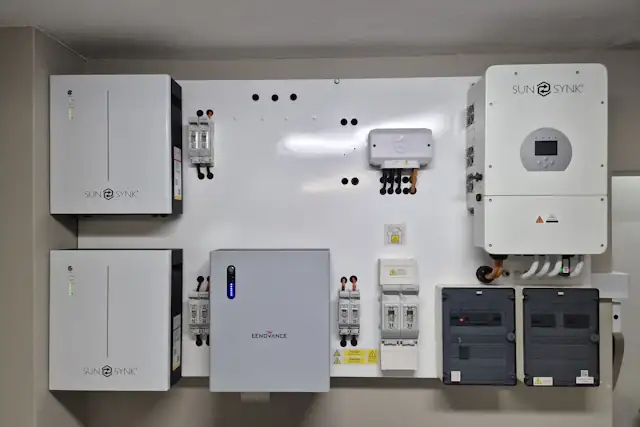
- Hybrid inverters usually have MPPT built in.
- Never exceed the controller's max PV voltage.
01How they differ
| PWM | MPPT | |
|---|---|---|
| How it works | Connects panel to battery in pulses | Converts panel voltage down, current up |
| Panel voltage | Must match battery | Can be much higher |
| Energy harvest | Lower | Higher, especially in cool or cloudy conditions |
| Cost | Low | Higher |
| Best for | Small lights and TV kits | Home and business systems |
02Sizing a controller
- 01Add panel powerFor example 4 x 400 W = 1,600 W.
- 02Divide by battery voltage1,600 W / 24 V = about 67 A, so choose a larger rating.
- 03Check PV voltageSeries panel open-circuit voltage must stay below the controller's maximum, with margin for cool mornings.
- 04Add a safety marginChoose a controller rated above your calculated current.
TipIf you're buying a hybrid inverter, the MPPT controller is already inside it. You don't need a separate one.
03Frequently asked questions
Is MPPT always better?
It harvests more energy, but for a very small, matched system a PWM can be good enough.
Can I use a 12 V panel on a 24 V battery?
Not with PWM. MPPT can work if the panel's voltage is high enough above the battery.
Does a charge controller power my appliances?
No. It charges the battery; an inverter converts battery DC to AC for appliances.